BLOG
Welcome to the Schultz Roofing resource center. Find expert insights on commercial roof coating costs, maintenance best practices, and industry updates specific to Central Pennsylvania businesses. Our guides are based on 500+ completed projects and 27 years serving the Harrisburg, State College, and Williamsport areas.
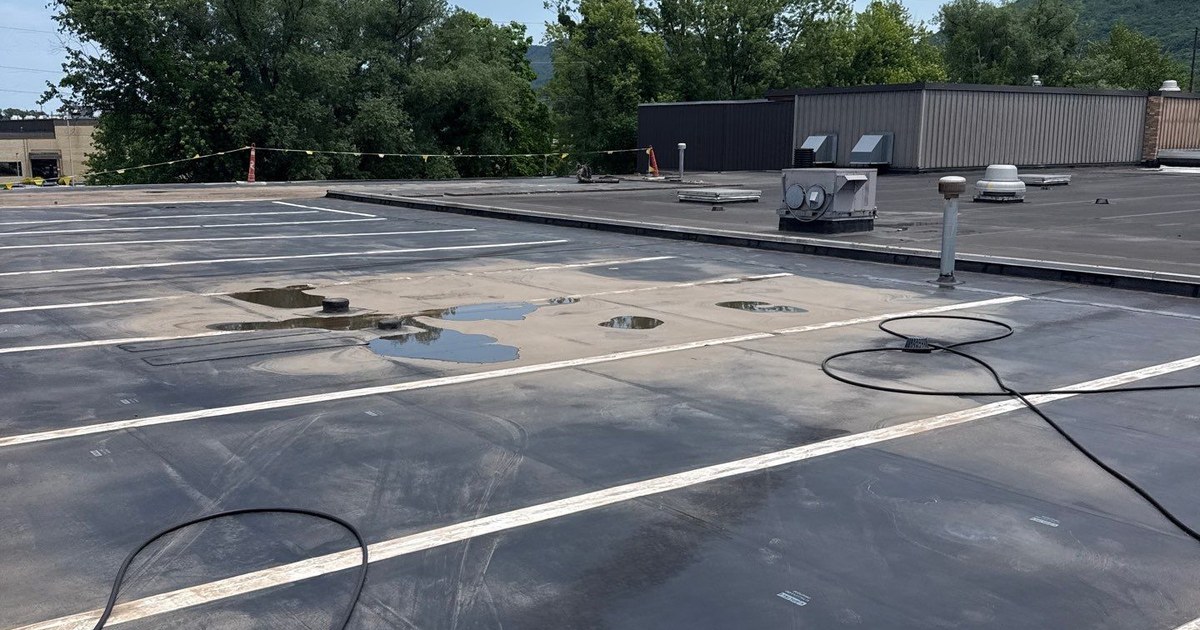
Commercial Roof Inspection Before Winter in Middleburg PA
Every fall, the window for meaningful roof work on a commercial building in Central Pennsylvania closes a little earlier than most facilities managers expect. Not because contractors get busy, though they do. Because the materials stop cooperating.
Most coatings and many adhesives carry a minimum application temperature, typically somewhere around 50 degrees and rising. Once overnight lows in Snyder County settle below that, a roof that needed restoration in October becomes a roof that gets a temporary patch in December and a full conversation again in April. The difference between those two outcomes is usually a single inspection done early enough to act on.
This is what to look at, and what the findings actually mean for a working facility.
What winter does to a low-slope roof
Central Pennsylvania is hard on flat and low-slope roofing for one specific reason: the freeze-thaw cycle. This region does not get a single hard freeze and hold it. It swings. Water works into a seam, a flashing detail, or a hairline split during a thaw, freezes overnight, expands, and widens the opening. Then it does it again the next week. A defect that would take three summers to become a leak can take one winter.
Thermal cycling compounds it. Membranes contract in the cold and pull at their terminations and fasteners. Anything already under stress, a seam that was marginal in September, tends to be the thing that fails in January.
Then there is load. Snow itself is rarely the problem on a properly built commercial deck. Snow sitting on top of standing water is a different matter, because ponded areas hold weight where the deck was never designed to carry it, and they are the last areas to drain when a thaw comes.
The fall walkthrough
Drainage first. Every drain, scupper, and gutter should be clear and running. This is the highest-value ten minutes on the roof. A blocked internal drain in November becomes ponding in December and a load question in February. Check that water actually moves toward the drains rather than away from them, and note any area still holding water more than 48 hours after rain. Standing water is its own problem and we have written about it separately.
Seams and flashing. Walk the perimeter and every seam. Look for lifting edges, open laps, and any place the membrane has pulled away from a vertical surface. Flashing at parapets, curbs, and walls is where most commercial leaks actually start, not out in the open field of the roof.
Penetrations. Every rooftop unit, vent, pipe, conduit run, and equipment curb is a hole in the roof that somebody sealed once. Check the sealant and the boots. Pay particular attention to anything a service technician has worked on recently, because HVAC and equipment work frequently disturbs roofing details and nobody tells the roofer.
Membrane condition. On EPDM, look for shrinkage, chalking, and splits. On metal, check fasteners and panel seams for backed-out screws and worn washers. On foam, look for surface damage and any exposed foam where the coating has worn thin. Exposed foam degrades in UV and it degrades fast.
Edge metal and terminations. Loose coping, lifted drip edge, and failed termination bars are wind vulnerabilities. Winter storms find them.
Then go inside. Ceiling tiles, wall staining near exterior walls, and any smell of damp in a storage area. Interior evidence often shows a leak the roof surface does not obviously explain, because water travels along the deck before it comes through.
Why the timing matters more on a coating system
If the inspection turns up a roof that is a candidate for restoration rather than replacement, timing becomes the whole decision. Coating systems have to go down within their temperature window and need a dry, prepared surface. That means fall work has to be scheduled and started, not just quoted.
A roof assessed in late August or early September can usually still be coated the same season. The same roof assessed in November generally cannot, which pushes the work to spring and means the building carries a known deficiency through the worst months of the year. That is not a catastrophe on a roof with minor issues. It is a real cost on a roof with open seams.
Document it, even when nothing is wrong
For a facilities manager or building owner, the inspection has a second purpose beyond finding defects. It produces the record you need for next year's capital planning.
A useful inspection report gives you photographs with locations, a written condition assessment by roof area rather than one overall grade, a note on the remaining service life of the current system, and a clear separation between what needs doing now and what can be monitored. That last distinction is the one that matters at budget time, because "the roof needs work" does not survive a budget meeting and "the northeast quadrant has three open seams and standing water at the primary drain" does.
It also builds a baseline. Two years of comparable inspection records tell you whether a roof is stable or declining, which is the actual question behind repair versus replace.
Getting it scheduled
Schultz Roofing works on EPDM, metal, foam, and traditional flat roofs for commercial property owners and facilities managers across Central Pennsylvania, including Middleburg, Trexlertown, and the Harrisburg area. Our focus is commercial, which means the assessment accounts for how the building actually operates: minimal disruption, predictable scheduling, and honest information about whether a coating system will get you more years out of the roof you have.
Roof assessments are free, and the report is yours whether or not you do the work with us. Emergency roof repair is available 24 hours.
Call (570) 274-2057 to schedule an assessment before the season closes.
Commercial Roofing Experts Since 1997


